What Are Core Web Vitals and Why They Matter for Your Website Performance
A beautiful website is not always a high-performing website. If a page loads slowly, reacts with delay, or shifts while a user is trying to interact with it, the experience feels unstable, even if the visual design looks polished. Core Web Vitals are Google’s way of measuring that experience through real, user-centered metrics.
The 3 Core Web Vitals Explained in Simple Terms
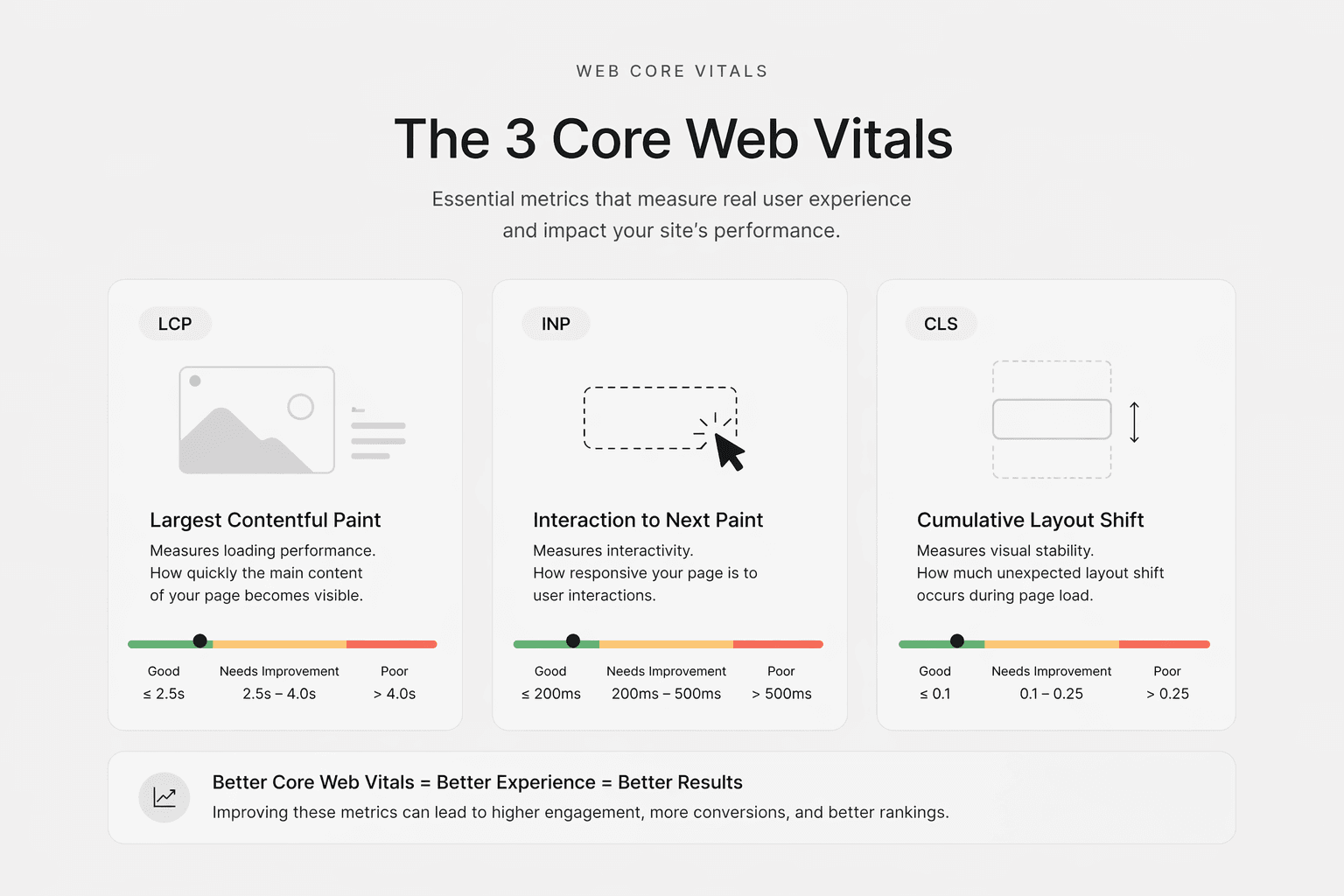
Core Web Vitals focus on three key aspects of user experience: how fast your content loads, how quickly your site reacts, and how visually stable your layout remains during loading.
Each metric has a recommended threshold defined by Google. When your site consistently meets these thresholds, users experience smoother browsing and businesses see stronger engagement.
1. LCP: How Fast Your Main Content Appears
Largest Contentful Paint (LCP) measures how quickly the main content of a page becomes visible. In simple terms: how fast your customer sees what they came for.
Google recommends that LCP should happen within 2.5 seconds. Between 2.5 and 4 seconds needs improvement. Anything above 4 seconds is considered poor.
If your hero image, product details, or key messaging load slowly, visitors often leave before they even see what you offer.
2. INP: How Quickly Your Page Responds
Interaction to Next Paint (INP) measures how responsive your site is when someone clicks, taps, or interacts with it.
Google recommends an INP of 200 milliseconds or less. Between 200 and 500 milliseconds needs improvement. Above 500 milliseconds feels sluggish.
When buttons lag, filters freeze, or checkout feels delayed, users lose trust, and hesitation directly impacts conversion rates.
3. CLS: How Stable Your Layout Feels
Cumulative Layout Shift (CLS) measures how much elements unexpectedly move while the page loads.
Google recommends a CLS score of 0.1 or lower. Between 0.1 and 0.25 needs improvement. Above 0.25 creates a disruptive experience.
If text jumps, images shift, or buttons move while someone tries to click them, the experience feels unreliable, even if the design looks modern.
Why These Metrics Directly Affect Revenue
Core Web Vitals are not abstract technical numbers. They represent real moments where users decide whether to stay or leave.
A slow-loading page increases bounce rate. A laggy interface reduces engagement. A shifting layout lowers trust.
For e-commerce stores, even small performance improvements can translate into measurable revenue growth.
Core Web Vitals and Google Rankings
Google uses Core Web Vitals as part of its ranking system. Faster, more stable websites are more likely to appear higher in search results.
Performance alone does not guarantee top rankings, but poor performance can limit your visibility, even if your content is strong.
In competitive markets, that difference directly impacts organic traffic and long-term growth.
After improving Core Web Vitals, Carpe increased conversion by 5% and traffic by 10%, resulting in a 15% lift in revenue.
Source: WPO Stats
Final thought
Core Web Vitals measure what users actually feel. When loading is fast, interactions are instant, and layouts remain stable, trust increases. And when trust increases, conversions follow. For growing online stores, performance is not a technical detail, it is a business decision.